Lately I have started to feel like a digital curmudgeon. This feeling started a little over a year ago, and I started bringing it up to my colleagues at conferences and in meetings. Some days as I review my newsfeed, prep for classes, write posts, or sketch out the weekly newsletter, it feels a bit like Groundhog Day.
History doesn’t repeat itself, but it definitely rhymes. In my work, one of our mantras is that the one constant is change. What makes these times interesting is that the change we’re seeing is all about AI. But what’s weird is that most artificial intelligence (AI) is learning from, and acting on, reverberations of datasets long gone. In many ways, we’re witnessing the ghosts of online reading comprehension past.
Every conversation about AI seems to begin with some version of the same claim. Everything has changed. Education has changed. Writing has changed. Knowledge work has changed. Literacy has changed. We need new skills, new frameworks, new curricula, new ways of thinking about what people need to know.
Some of that is true. But I’m wondering how much of this is actually new.
Yes, there are things happening in machine learning and AI that deserve to be treated as genuinely new. A system can now respond to ordinary language by producing usable text, images, code, audio, and video. Increasingly, it can search for information, use tools, interact with other systems, and carry out parts of a task on our behalf. Generated language can arrive fluent and persuasive without the familiar markers we once used to inspect a source. And the infrastructure required to support these systems is becoming visible in communities through fights over electricity, water, land, and data centers.
Those changes matter. They create new possibilities, new risks, and new political questions.
But I also keep having the strange feeling that I have heard this conversation before.
Computer literacy. Information literacy. Media literacy. Web literacy. Digital literacy. Data literacy. Algorithmic literacy. Now AI literacy. I’ve been waiting for, and have already started to hear, folks talking about quantum computing in my circles.
Each new technology arrives with a vocabulary for describing what makes it different. Often that vocabulary is useful. The web really did change publishing. Search engines changed how we find and encounter information. Social media changed participation, visibility, and circulation. Mobile devices changed where and when we connect.
The mistake is not noticing what is new. The mistake is assuming that everything is new.
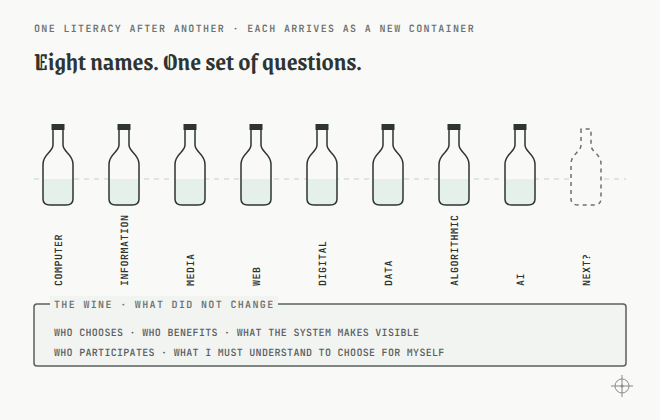
Figure 1. Each new technology arrives with its own name for what makes it different. The container keeps changing. The questions underneath it have not.
What is actually new?
Mind you, I do think there are some things that are new and novel as we think about AI in our lives. We have real problems and serious consequences to discuss as a society. But mostly we seem stuck in hype, hyperbole, and hysteria.
What strikes me is how quickly the genuinely new questions get entangled with much older ones.
Listen to people argue about AI data centers and the conversation soon turns to who pays for the electricity. What does this do to infrastructure? Who controls the water, and what does that do to the local ecosystem? In a recent newsletter I wrote quite a bit about who receives the tax benefits, whether a community gets a meaningful say, and whether anyone believes the companies promising that everyone will eventually benefit.
Listen to arguments about AI in schools and the questions become similarly familiar. What or who should we trust? What should we hand over? Do we ever fully know what we’re handing over? What happens to the data and the content about us once we do? Who gets to make the rules? What happens when a system becomes convenient enough that we stop noticing the choices it is making for us?
Those are not principally questions about artificial intelligence.
They are questions about what happens after people have been burned by technology enough times to stop taking the sales pitch at face value.
We have heard promises about connection, efficiency, access, personalization, disruption, democratization, and innovation before. We have also watched platforms centralize power, harvest data, reshape public life, change the terms after adoption, and leave communities with little say over the consequences. We’re told that we need to migrate to a new platform or tool simply because it’s “better.”
So we are seeing people ask harder questions now about AI and, specifically, data centers. Who pays for this? Who profits? Who gets displaced? What happens to the data? What becomes dependent on the system? What happens when the company changes the rules? Can a community say no? Can a school? Can an individual?
That skepticism is not evidence that people don’t understand technology. In many cases, it is evidence that they understand the pattern.
Old wine, new bottles
This is where my own field has something to offer, because literacy researchers have been wrestling with versions of this problem for decades.
Brian Street pushed back on the idea that literacy is just a set of skills you learn once and then use anywhere. He argued that literacy always happens in a real situation, shaped by the people involved, the rules of the place, the tools being used, and who has the power to make decisions. The New London Group pushed further by suggesting that literacy is not only about understanding what other people make, but about understanding how meaning gets shaped and having some ability to shape it yourself. Lankshear and Knobel indicated that a new tool does not automatically create a new kind of literacy. What matters is whether it actually changes how people create, work together, share ideas, and participate.
The point was never that the technology didn’t matter. It was that a new technology did not automatically erase everything we already understood about how we read, write, connect, and participate.
Which brings me to an idea that keeps surfacing in my thinking: old wine in new bottles.
Old wine in new bottles describes taking an existing, familiar idea, concept, or practice and repackaging it in a fresh, modern format to make it seem novel. The phrase seems to be a modern inversion of a famous biblical parable attributed to Jesus in the New Testament. This concept is sometimes confused with the similar, but quite different, phrase new wine in old bottles.
For my purposes here, old wine in new bottles is useful because it gives us a way to ask whether a new technology is actually changing a practice or simply giving an old practice a new container.
We have seen this for decades.
Putting a worksheet online does not necessarily change the learning. Turning an essay into a blog post does not automatically change who can participate or who has authority. A classroom can adopt a learning management system and preserve the exact same structure of assignments, submissions, grades, and authority.
In many instances, the bottle changes; the wine does not. There are definitely times when the bottle changes the wine.
Publishing to the web is not simply printing on a screen. Hyperlinks change how texts relate to one another. Search changes how authority is encountered. Networked communities change who can participate and who can respond. A smartphone is not merely a smaller desktop computer.
And AI is changing what can happen between a person’s intention and the finished result. That is the distinction I am trying to hold onto.
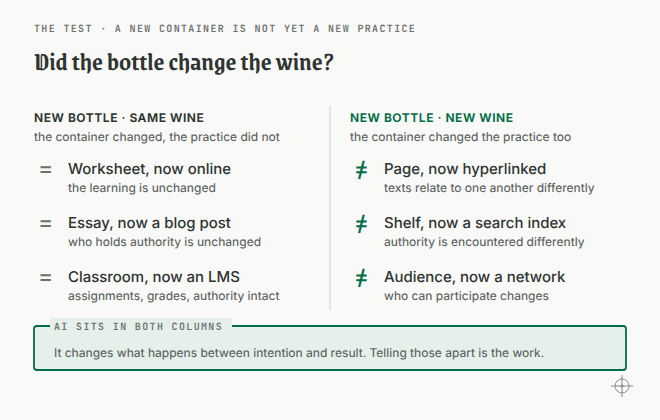
Figure 2. A new container is not automatically a new practice. The test is whether what people actually do has changed, and AI is the case still being argued.
Not everything new is merely old wine in a new bottle. But neither should every new bottle convince us that we have never tasted anything like this before.
I think there are genuinely cool and interesting things happening with AI. I also think there’s a real chance this all goes badly. And I keep feeling that we have been here before, and that we should have learned some lessons by now.
What should travel?
What worries me is that we have a habit of responding to technological change by teaching the bottle.
We teach people how to use the current interface. Where to click. What to type. How to search. How to submit. How to format. How to write a better prompt.
Those things matter. People need functional knowledge. You cannot critically examine a system you cannot operate at all. But knowing how to operate the current interface is not the same thing as being prepared for the next one.
And there will be a next one. That is the one prediction about technology I am completely comfortable making.
The bottle will keep changing.
What I hope we’re starting to do is gain our footing and respond as more critical consumers and participants in a global technological ecosystem. Across computer literacy, information literacy, media literacy, web literacy, digital literacy, and now AI literacy, the same questions keep following us.
Who is making the choices? What does the system make visible or invisible? Who participates? Who benefits? What do I need to understand before I can make a meaningful choice of my own?
Those questions are not really about AI. They are about trust, authority, participation, consent, ownership, and power.
New technologies give us new things to think about. They create new possibilities, new risks, and sometimes entirely new practices. But if we treat every technological shift as year zero, we throw away decades of hard-won understanding about how people encounter systems, institutions, information, and one another.
That is what gives me the Groundhog Day feeling. Not that AI is unimportant. Not that nothing has changed. And not that people’s concerns are misplaced.
It is that we keep meeting new technologies as though we have never had to think through any of this before.
Sometimes the bottle changes and the wine stays mostly the same. Sometimes the bottle changes the wine too. The work is figuring out the difference, and deciding what we need to carry from one bottle to the next.